The small things that make the long hiking days bearable and give some moment to breathe and settle my mind into the environment are a bit overlooked. The big spaciousness and broad images of hill tops, lochs and glens take most of the space in my phone. Big things are magnetic, exhilarating, and exciting. They make me want to run and scream some days, others it makes me feel small and irrelevant in the magnanimous time these things exist. Their time, a concept, we can only imagine and conceptualise but have no practical understanding of their lives beyond what they mean to us. The ancient hills, eroded through glaciations, the lochs and rivers empty or full across many centuries, changing but (so far!) always existing.
the smaller the thee small thing, the slower the time feels
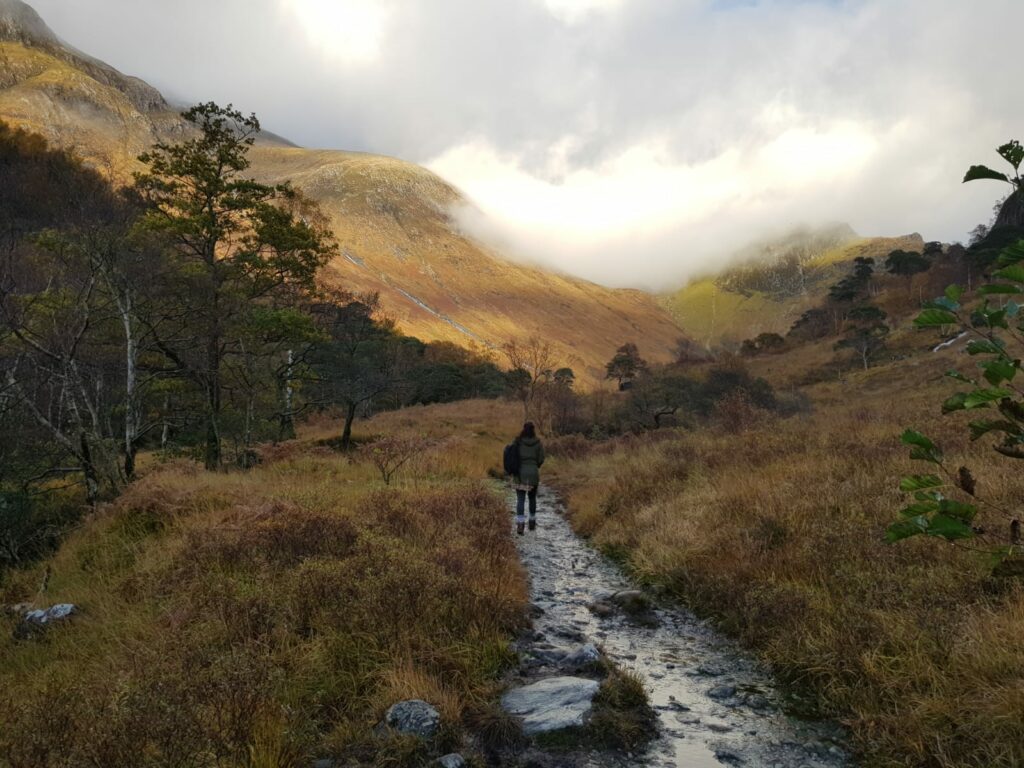
The small things may not be there the next time I walk that path. They might go unnoticed in the totality of their existence, unseen from being to end. Some streams will only run once and then, like nothing ever wet that crevasse, plants, and moss will grow and its existence short but productive, leaving moist in the soil to need life to exist. Most of us are like that, will cease to exist without many traces and will become soil. Other’s their memories or their deeds will live further, but eventually, too, fade away and be forgotten. You know that moment when the two hobbits are leaving behind the rest of the fellowship, stressed , anxious and filled with dread, something tiny and yet wield the strength of hope and foretelling happens. The light of the sun shines through the trees and hits on the decapitated stone heads of the statues of kings of old time. Frodo notice and calls on Sam to look at them and for that second they hope and strength is restore.
forests floors are other worlds, worlds one day we’ll be food for
The small things can make big things happen. You know that moment, when the two hobbits are leaving behind the rest of the fellowship, stressed, anxious and filled with dread, something tiny and yet wield the strength of hope and foretelling happens. The light of the sun shines through the trees and hits on the decapitated stone heads of the statues of kings of old time. Frodo notice and calls on Sam to look at them, and for that second they hope and strength is restored.
By now, the small things become big things, their impermanence an act of rebellion and surrender against the fleeting of their existence, like saying out loud…” I am here, right now, and I shine”. Maybe not tomorrow, may be, never again… but now. They take up space, they create memory, they change the mood. They change time. The time they exist is to us what we are to the ice eroded hills, a nothingness. Yet, just like us, can change everything. For good or bad, in the eye of time. (I hope you can sense in this my environmental claim).
A butterfly on a Munro… the biggest ben and the smaller bagger…
I It is almost midsummer night and the strawberries in my garden are still a greenish white unripe colour. Last year, today I returned from the East2West trail, and I was eating strawberries from my patch every day. Summer is not yet here and I can feel it. There is a lingering tiredness that reminds me of the old rat race life back in the Netherlands. Therefore, instead of pushing through long trails, I took some Munro days and pushed hard through my leftover winter blues.
There is a big difference in the type of fitness necessary for munro bagging or long-distance mountain trekking. It is not just the gear you carry, but the energy expenditure management, the feeding and drinking pattern and the rest between strained efforts. In both cases, I have found myself walking distances between 12k to 40k in one day and elevation gains of 1500m (in Scotland). While on a munro day you carry a max of 6 kg of luggage, I have carried about 18 kg through my long trekkings.
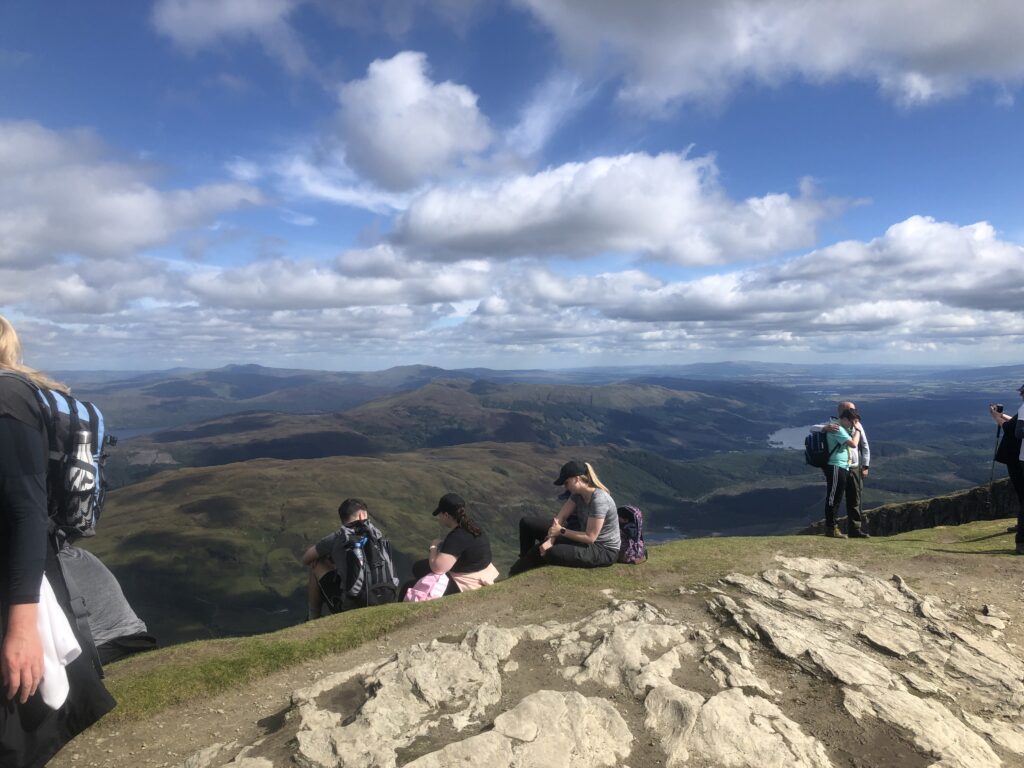
The only munro I hiked with a backpacking tour was Ben Lomond. It was the first and the last I bagged with a giant backpack. When I got to the top, the people who kept passing me as they ascent with no bags started clapping. I didn’t really know I was going beyond the normal efforts. I usually begin my munro days after a well slept night in a bed and a good breakfast, ride, walk, and return to that same good bed, food, and shower. Trekking finds me day after day sleeping outside in a tent, on a mat. On a munro day, I might stop twice for food, a snack stop and a lunch stop. On a hiking day I will stop at least 3–4 times, take a good stretch, drink and eat regularly snacks. The energy expenditure might be similar, but I don’t get to rest and stuff my face the next day. Thus, they are unique in timings, confort and recovery. Now, I wonder, how can I do both through a very lengthy trek, from the borders to Cape Wrath?
Big bag day up Ben Lomond, 2021
For my next challenge, I have been studying maps and reading stories of a longer cross-country hike in Scotland. tHis unmarked path requires both, long days of walking and going up some munros, bealachs, and walking along ridges while carrying gear to overnight and food for several days. I am not sure that I can make it this year, work, family business and my current fitness level might need more time to get ready for this demanding trail. And, spring is just over. So the goal is to do this next year May and June. Meanwhile, I am taking the rest of this summer and autumn to train, test, asses gear needs, navigation, food, etc.
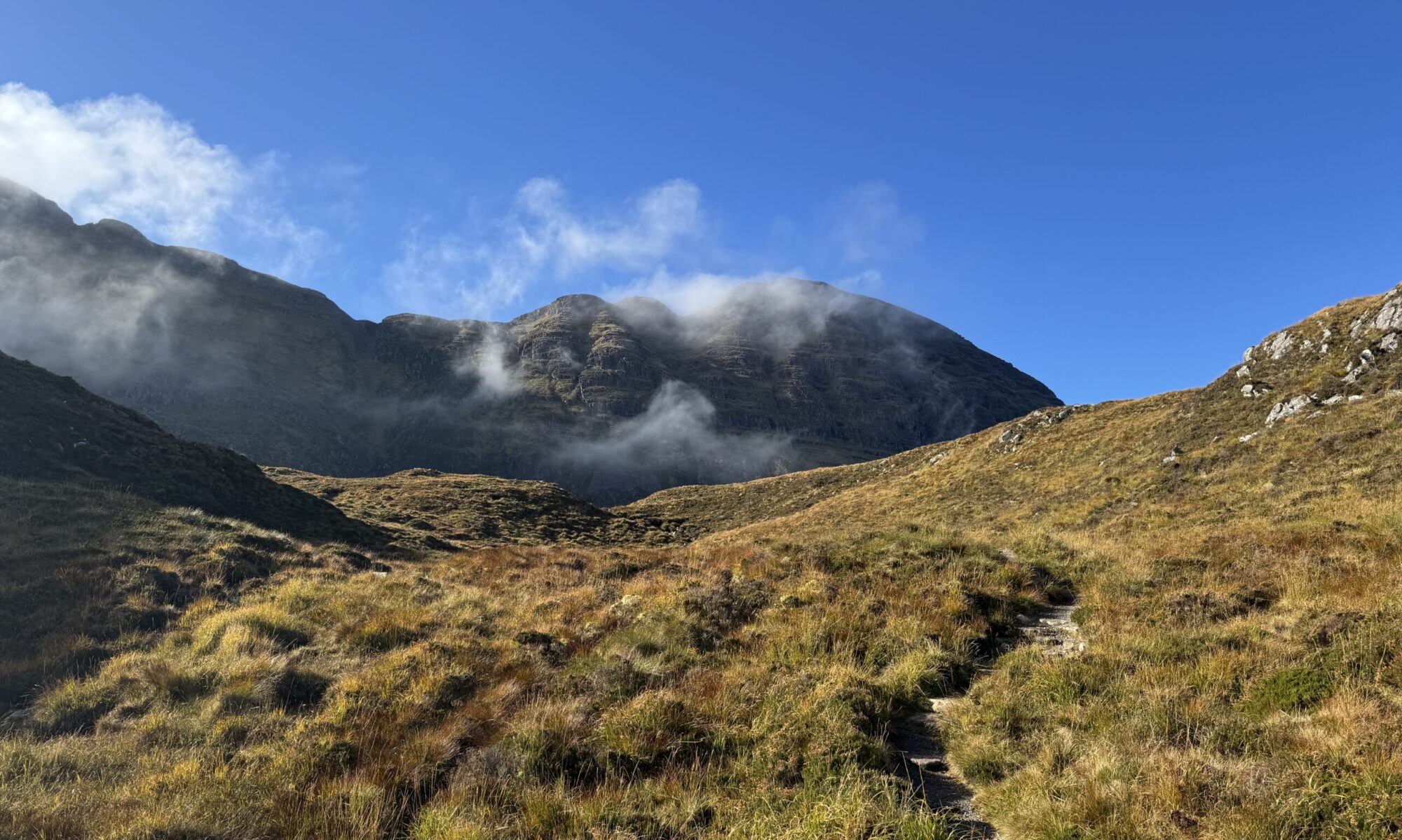
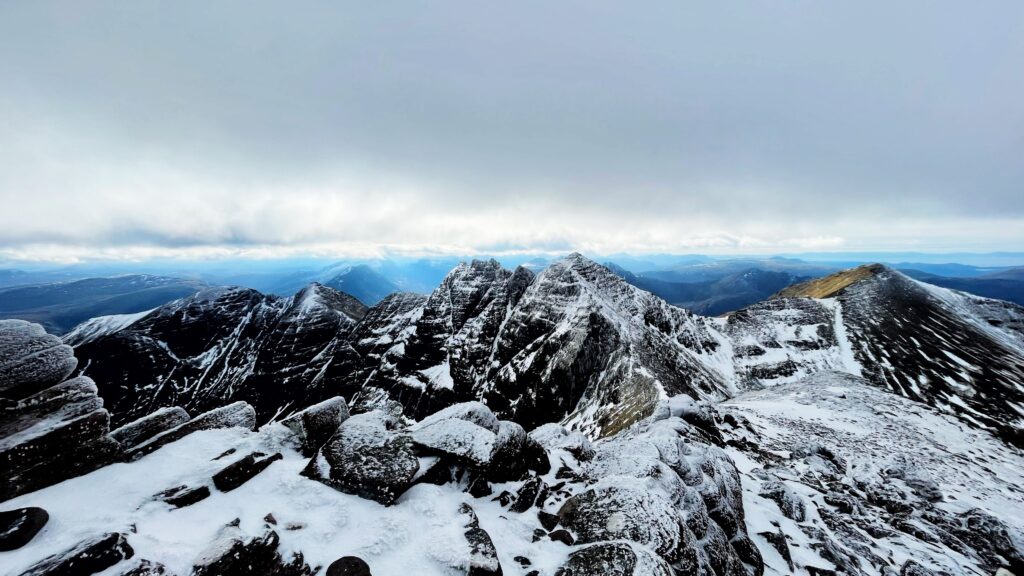
Beinn Bhrothain, 2026
Ia m not sure why I am taking on this personal challenge. I am sure I will be thrilled to spend 6–8 weeks in the hills. I am not a competitive person, I can’t care enough about anything to compare myself to others or to waste my energy on building a false sense of superiority. My achievements in any areas are to prove those interiorised critics from childhood and teen years how wrong they were. And to spend time outside, in silence, with myself reflecting, rethinking and thus rewiring myself.
I’ve been up 5 Munro’s in the last two weeks and I’ve learn so far that, I need lighter gear, that I will need some navigation tech and not just my OSMap app/paper maps and that I will have to re think shoes, as trail runners have been useful but will wear off sooner than later during such a long trail… Oh, and that I shouldn’t do leg day before a hike.
Transcribed from a voice note made on the last leg of the Affric- Kintail way, last april, after a couple of days off the grid.
AKW, 2026, Early spring.
My world is what I make of it.
Or maybe more precisely—the world I live in (with you) is the world I can describe. And what I can’t say, what I can’t name or describe, is my world and only mine to experience.
I keep thinking since my first read of Ludwig Wittgenstein’s Tractatus Logico-Philosophicus—that the limits of our language are the limits of our world. Yet this world is not a shared world. Because what he says is “The world is my world: this is manifest in the fact that the limits of language (of that language which alone I understand) mean the limits of my world.” (5.62, 1921)
Because if that’s true, then each of us is, in a way, creating a world through their use of language, how you choose to talk about things to others and to yourself. Not from nothing, but from how we define things, how we name them, how we organise experience. And what value we give them. How they stand in our knowledge organisation, pin our mind castles. These definitions don’t come from nowhere.
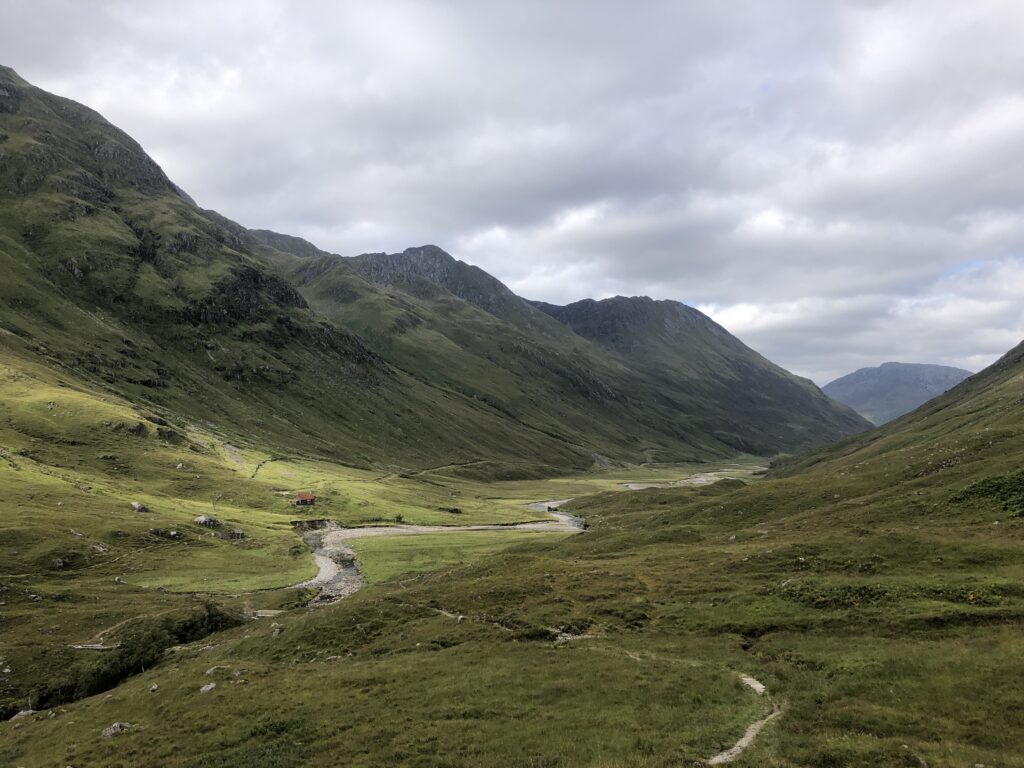
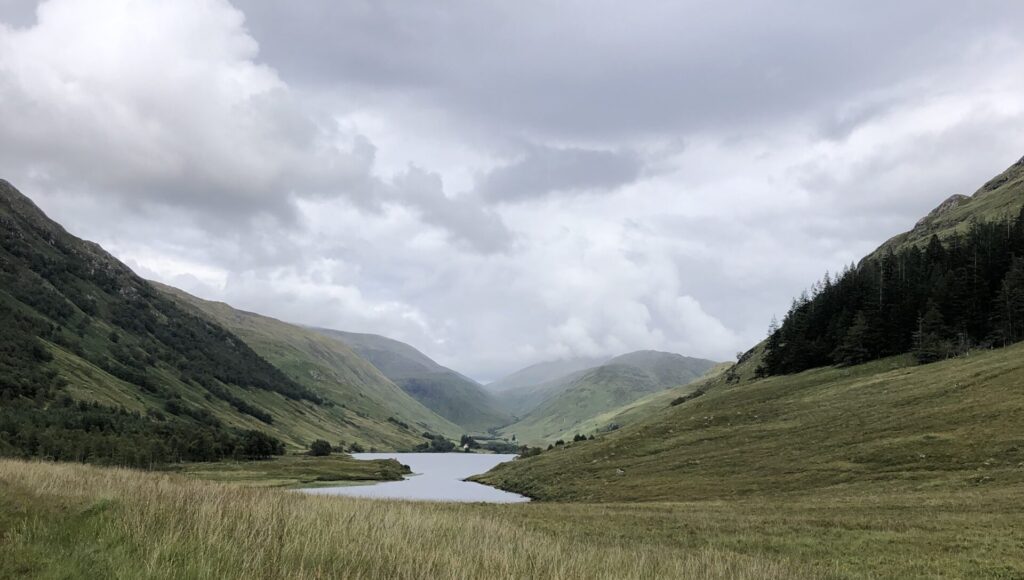
Glen Lichd towards river Croe, 2021, 1st AKW, Summer.
They’re inherited—built up over time, through culture, through history. Almost like an organic system. Not designed, but grown. So the “rules” of the world—what is right, what is wrong, what makes sense—they’re not absolute in the way we often assume. They’re the result of long processes of thinking, of conversing, of exploring.
And maybe that’s why the structures that institutionalised religions offer are so attractive to some. Not just as belief systems, but as shared frameworks— ways of interpreting the world so that people could feel that they share a thought, a form of grounding in shared experience. In this way they can act together, exist together. A language for reality to be shared from the subjective experience.
But now it feels like those shared rules are breaking down faster than ever before. Or maybe not breaking—but being replaced, or being distorted, by forces that aren’t really our awareness, our direct experience. And so we start questioning everything again. And this is where it gets vague, as where are the boundaries of this change, and where should we set it free.
Because I was thinking about that idea—like when someone says “God is dead,” like Friedrich Nietzsche did— it’s not just about belief disappearing. It’s about a whole system of meaning collapsing. What we do now feels like trying to revive that system— or replace it—using the same kinds of thinking that created it in the first place. But something doesn’t quite work. Because when you’re out here—in nature— everything feels connected in a way that doesn’t need explanation. It just is. It’s immediate. It’s organic.
2nd AKW, 2022- Glen Lichd & River Croe, end of summer.
And then the mind comes in and starts categorising, naming, structuring— trying to pin it down. Then in doing that, it creates a different kind of reality. A double piramidal structure where things, people, feelings, etc. are either above or under others, with an apex as goodness and the other as badness/evilness. This structure is a rigid one. A more artificial one. I think that’s the tension.
The systems society has built—the concepts, the philosophies, the language— were useful once. Maybe even necessary. But some of them surely no longer fit the way the world’s being currently experience. They’ve become… obsolete, in many ways. And yet some still think through them. Society still relies on them to define what is real, what is true. Inconsistent and outdated.
So maybe the problem isn’t just the world changing—but that our ways of thinking haven’t caught up with the shifting that has already happen. ~There is not way to return to the past. What is known, can’t be unknown.
As the days pass by, I have talked about this trek with a few friends and ‘conocidos’ that have seen some of my Instagram photos. I have answered several questions, such as: Aren’t you scared? How do you sleep? What do you eat? What do you wear? How do you stay “clean”? How you know where to camp? How do you deal with threats? My human network is very colourfull; some have never set up a tent in their lives (or ever will, right, Aimi?), some are highly experienced in the outdoor world, and some are keen but unsure how to engage. I love to surrounded myself with people who are not only interested in the same things I am or have made the same life choices. Inclusivity is a core value. As in, “so long as you are not a prick, I’ll be happy to hang out” but of signs of conscious prickness arise, I’ll walk the other way. No look back, no grudges held. Like gear, is no point taking on what drags you down. Ok, back to gear:
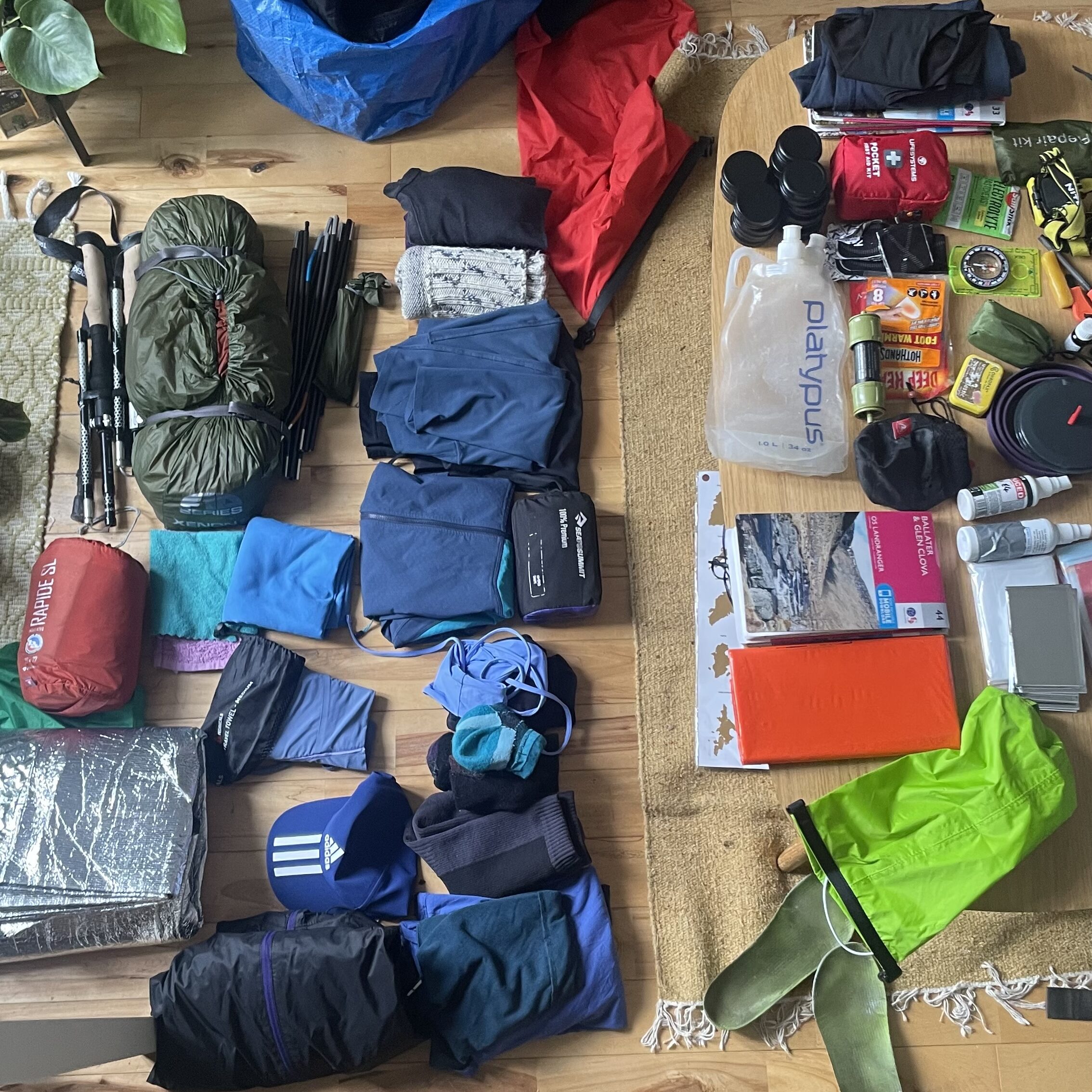
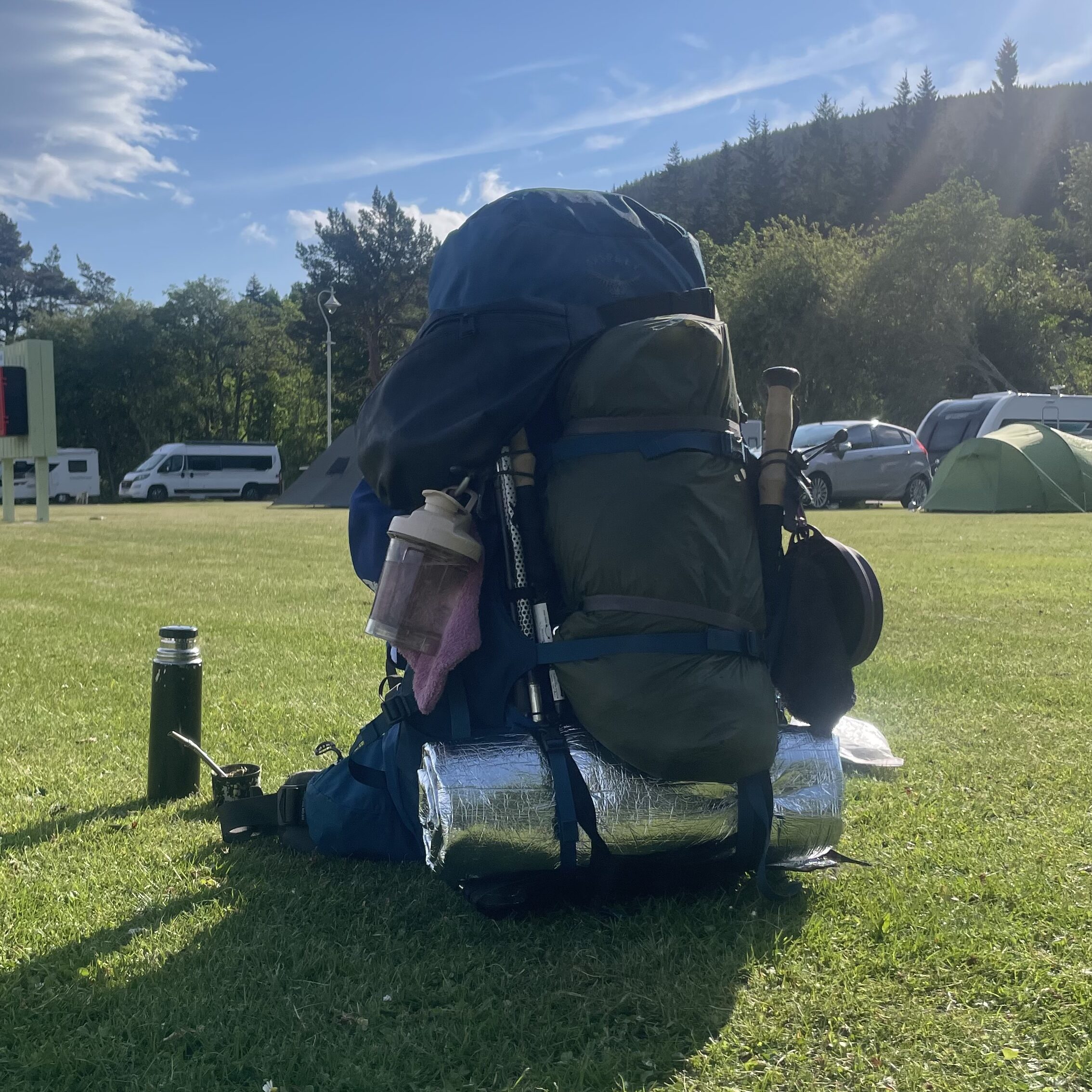
Main gear: F10 Xenon tent, Vango – Rapid SL sleeping mat, BigAgnes – Cotton Linner, Sea2Summit – Backpack Aether 65L, Osprey(not in this picture), OEX Leviathan EV 900 sleeping bag (not in this picture either).
Kit: Alpkit Hippo Water Filter + 1 x 1Lcontainers, Alpkit titanium 900ml cooking pot, Robens Fire Beetle stove, Alpkit Jasper Fire lighter, head torch donation from someone I can no longer Platypus water remember, but it is still working. First Aid kit from go outdoors, but tailored to my needs includes KT tape, teatree oil, beeswax, beeswax&cotton earbuds (are great fire starters), a tincan with dry tinder, an emergency blanket and an emergency shelter bag, two emergency flou lights, compas, maps, hand and feet warmers, a whistle and two different type of midges/tick repellents.
Gear fails, yes, quite some. Gear triumphs, yes, of course. My tent is glorious. It is not as light as I would recommend others, but I don’t mind the weight if it means I can really stretch and pack dry in the morning. My tent is a Vango Xenon UL, which is about 4 years old, and it has been pitched more than 200 nights since I bought it. I love it. The poles are a battered now, bended by some extremely strong winds in Glen Etive (2021) and Iona & Mull (2024). Yet, this tent has always kept me safe and dry. I can order replacement poles easily but is still ok as it is.. It’s a tent that I can pitch in 6 minutes, pack up in less time, and sit straight. It keeps all my stuff inside and has a porch to cook on when the weather is unkind. It fits comfy two humans, and is a great hang out space when it daggles. Love it.
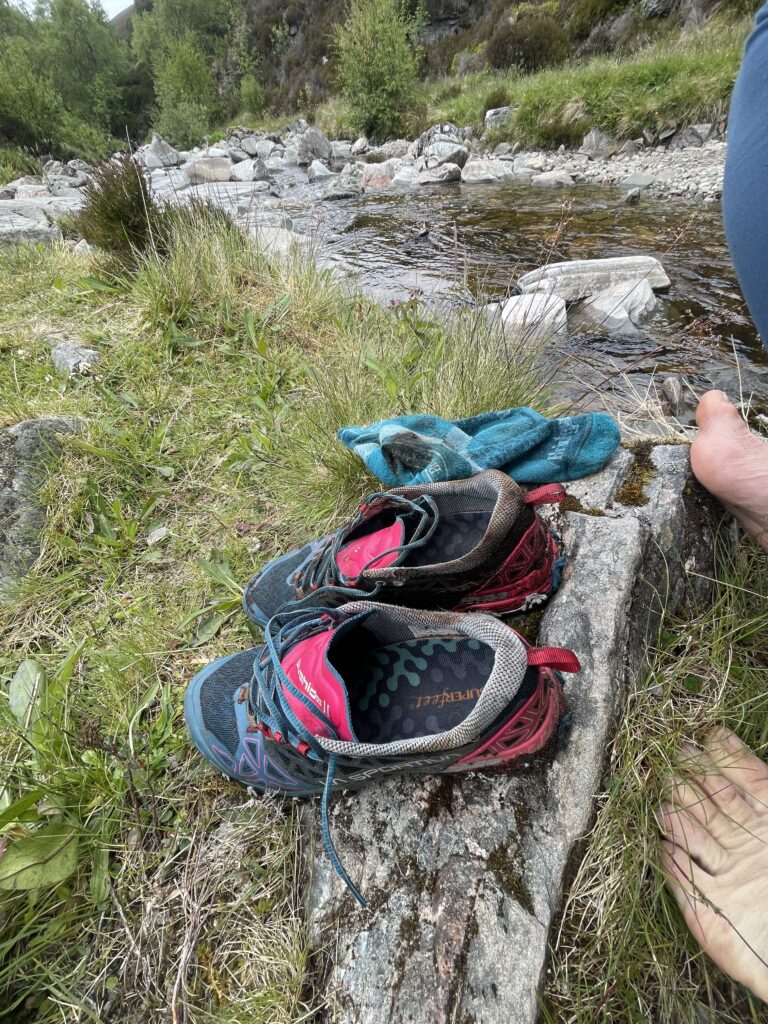
Another gear triumph, were the La Sportiva Bushido 2 trail runners. First time taking trail runners on a long trek and not hiking goretex shoes. Now, considering that trail runners carry almost nothing on their backs, and I had about 20kg all the way through the shoes did ok. They were light, grippy, and dried relatively quickly, either overnight or while wearing them (with trail running socks) I prefer them now to waterproof shoes. Paired with sealskin socks on very wet days or long boggy stretches, they were no fuzz at all.
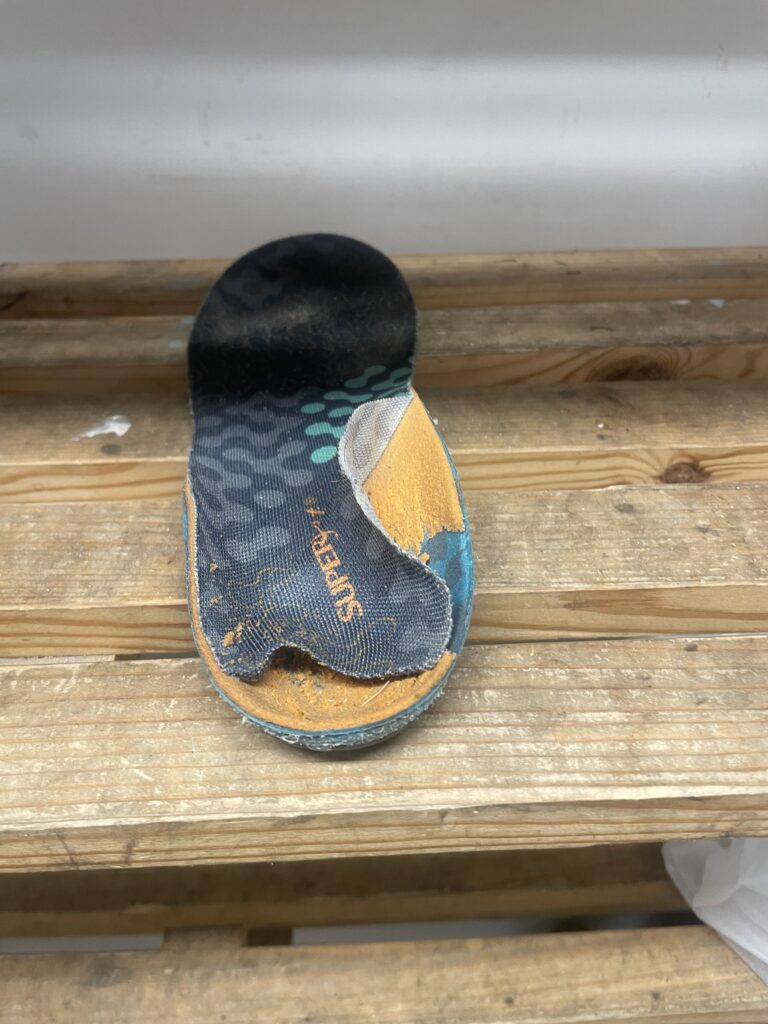
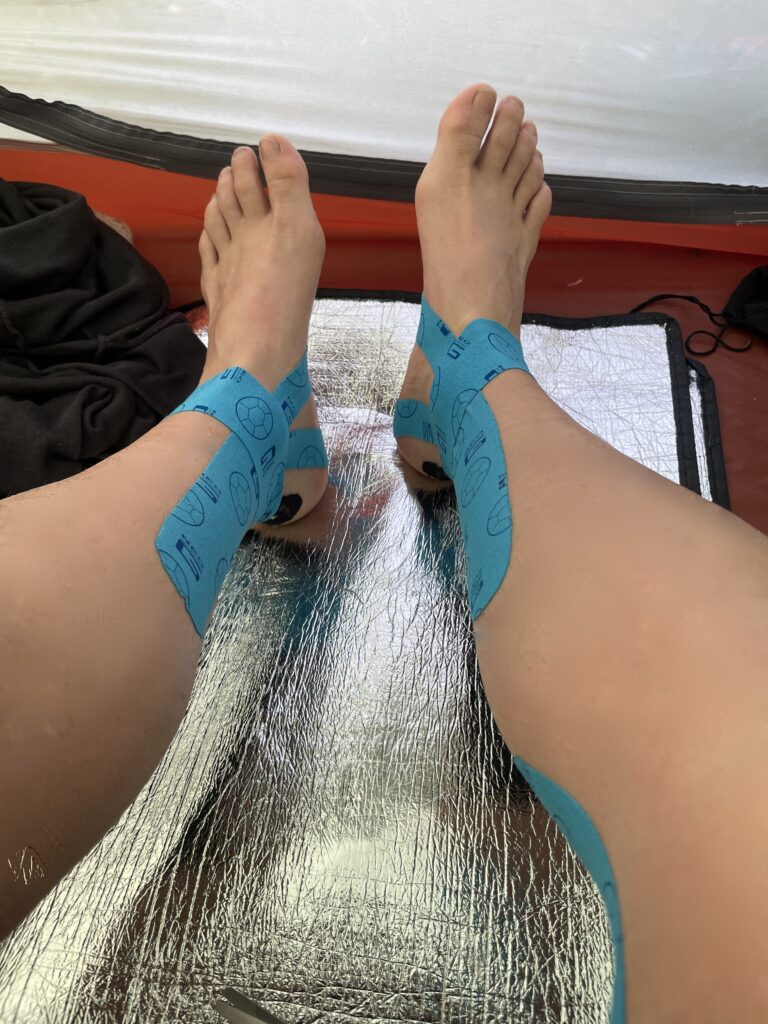
However, I had extremely painful calves & ankles the last week. I had bought a pair of medium arc insoles, a recommendation from the shop. The Superfeet Active Cushion Medium Arch Insoles, for £30 (😥)that should last about a year or 500 miles, and they were worthless just after I hit 100 miles. The result was an incredible amount of ankle pain, calf cramps, and tender knees before I hit day 5. I didn’t realise that the insoles were the culprit for some days and marched on with all the pain untreated. By day 8, I was taping the aquiles tendon, and by day 10, the whole ankle. Got cuddos from my sports masseur for the effective KT taping, inspired by tapping Eli’s ankles when he plays basketball.
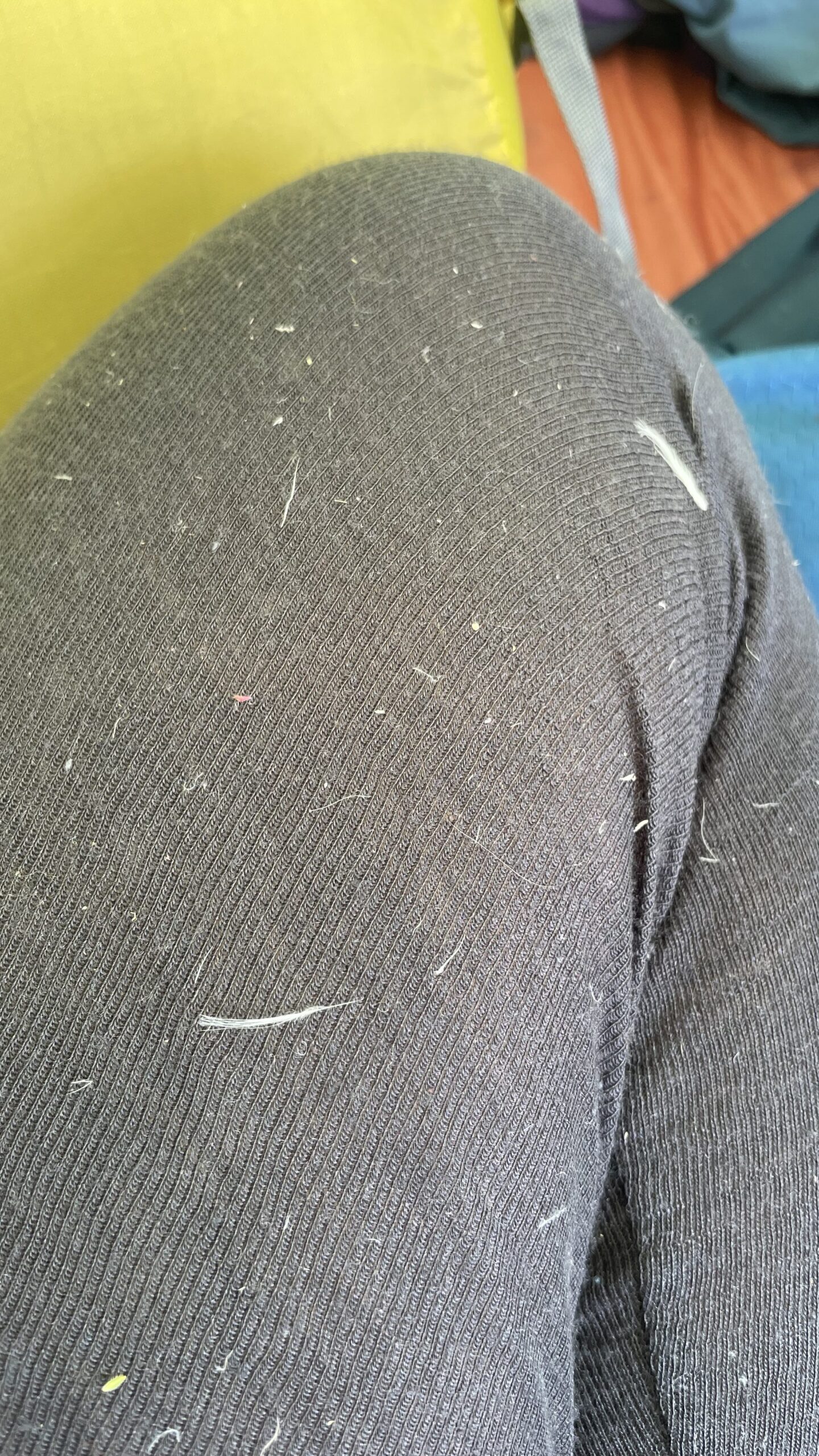
The state of this insole says it all. Less than 200mi walked in them, worthless.Daily KT taping of ankles due to bogs and fording, the tape would be useless at the end of the day, but a very welcome support.
Meanwhile, a gear failure was the trekking poles; they both broke down while navigating mud and bog on the right side of Uisge Labhair. They both got so deep in the bog that they created a strong vacuum, and as I tried to pull them out, the bottom third stood inside the bog. There I was, in the light rain, digging bog to rescue the poles, drying them with my towel, and putting them back together with the bits of silver tape I had rolled over the midgies’ spray bottle. It was not a terrible thing to happen, but it was an inconvenient moment on a part of the trail that was pathless due to rain, mud and bog.
Lastly, I am still undecided about the new “4-season” down sleeping bag I purchased from OEX. Not the best brand, clearly, it kept me warm, especially the one night camping outside Culra bothy, which was extremely cold. However, I would wake up covered in down, the tent looking like a cockfight ring. By now, I believe it has lost enough down to be a 3-season sleeping bag. Disappointed, yes, a total failure, not really.
not a fun pillow fight…
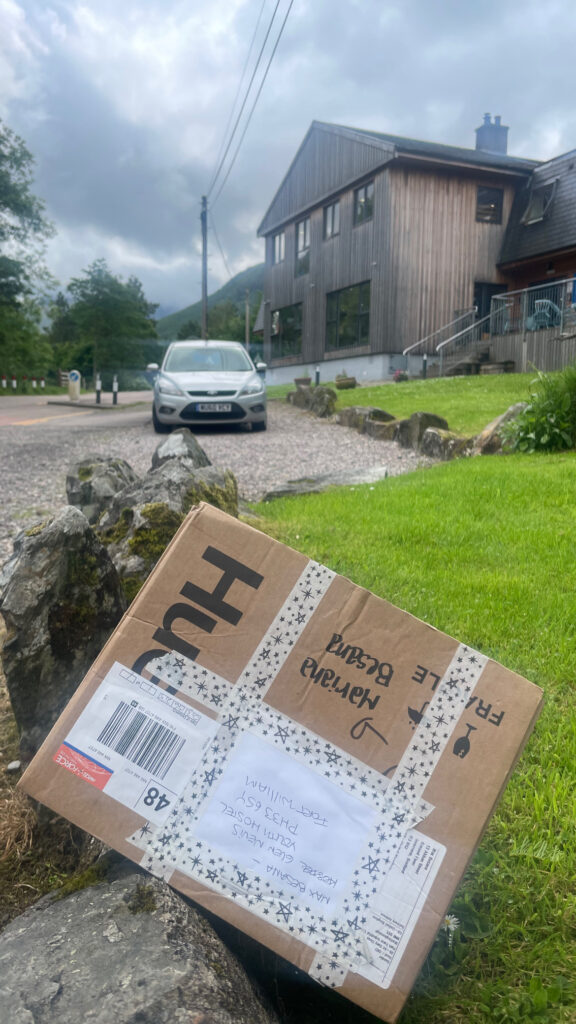
The last of the problems I encountered was the food. I had prepared supplies based on caloric needs and gave high importance to proteins, hydration/electrolites and rich caloric food. I did not want to lose too much muscle gains as I had been training quite hard in the last six months. However, as efficient as I am, the system failed me and I ended up losing about 4kg and went down in my lifting by about 20-25%. The trek days were long, the temperature quite cold, and the terrain, the last week, was quite challenging. I had posted supplies to Fort William and they got lost due to a double failure: I paid for a 48-hour service that took 168, the same amount of time it took me to walk from where I posted to where I was hoping to receive the package (Braemar -Fort William). The second failure was even more irritating, and that was the lack of kindness and attention that the staff from the hostel demonstrated as the package arrived day I was waiting in Fort William, at the hostel t and no one contacted me to let me know. I spent a day in Fort William spending money on less nutritionally efficient food and an extra night in a hostel for nothing. I could have had my maps, my clean leggings, my two squeezy bottles filled with peanut butter and honey and many other amazing things I had prepared at home. When I raised the complaint to the Hostelling association, all I got was a will deal internally with the unkind, slightly racist wee “sorry” we and resentful staff member. I don’t usually Karen these things as I know how innefective the system is, so Tom, you know you are a proper jerk.
Further on, gear wise I am still happy with everything else I own, but I am contemplating a longer and much more demanding trek next year where light, less bulky everything will be needed without compromising watertightness, warmth and wind protection. If you have questions or suggestions, leave a comment, I am always open to learn and to share my knowledge. Keep it kind, keep it light, Like the gear.
Back home, my body is very achy, there is still mud under my nails, and I am hungry all the time—the aftermath of the mad two weeks in the wilderness, carrying all I needed on my back.
The trail depression kicked in as I left Eigg last Monday, and I was being driven to Fort William. After I finally got hold of the damn parcel I wondered if I could continue. But my left hip begged me for a rest, so I headed back home with the bus, feeling like there was more to be done than I did—an insatiable hunger for wild things.
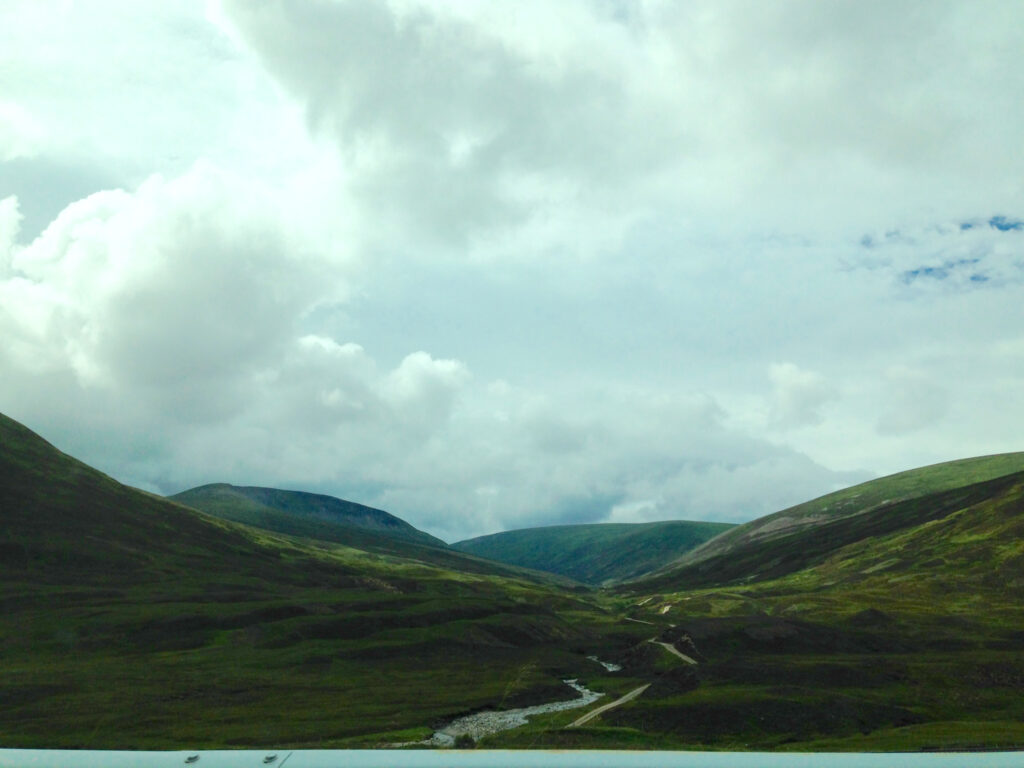
The path I traced followed some places I’ve seen from afar, in other walks, or while travelling by wheels. Places like Loch Erich and Ben Alder, Dalwhinnie, Glenfeshie, Rannoch Moor, Glen Nevis, Glenfinnan and Knoydart I’ve seen from afar, and my mind would fly over there and imagine how it would feel to be alone in the middle of these landscapes. Like the first time I visited the Highlands, it was in 2016, and I was travelling with my friend Chita’s family to Elgin, where their ancestors had left Scotland for Argentina in search of a better chance at life. As we drove through the A9 from Edinburgh, passing by Dalwhinnie and the distillery, the landscape opened up, and I felt as though I was in the middle of a dreamscape: remote, wild, and desolate.
Somewhere of the A9, close to Dalwhinnie, from the moving car, 2016.
Back in the Netherlands, the flattest country in the world, I would stare at this picture, dreaming of hills again. My life was then very different, and I was in the midst of the worst storm I had ever experienced. I fell in love with this country all over again, after my first time visiting, just before Eli (my 6’6” teenager) came to exist, and I travelled with my sister. On the trip, we took the train to Fort William to Glasgow, and there I saw Glen Nevis, and once more I dreamed of roaming those green hills with the one who was my fiancée at the time. Sadly enough, he was not as adventurous as he painted himself and never wanted to come to Scotland with me, so here I was, freshly separated, and my first trip was to Scotland.
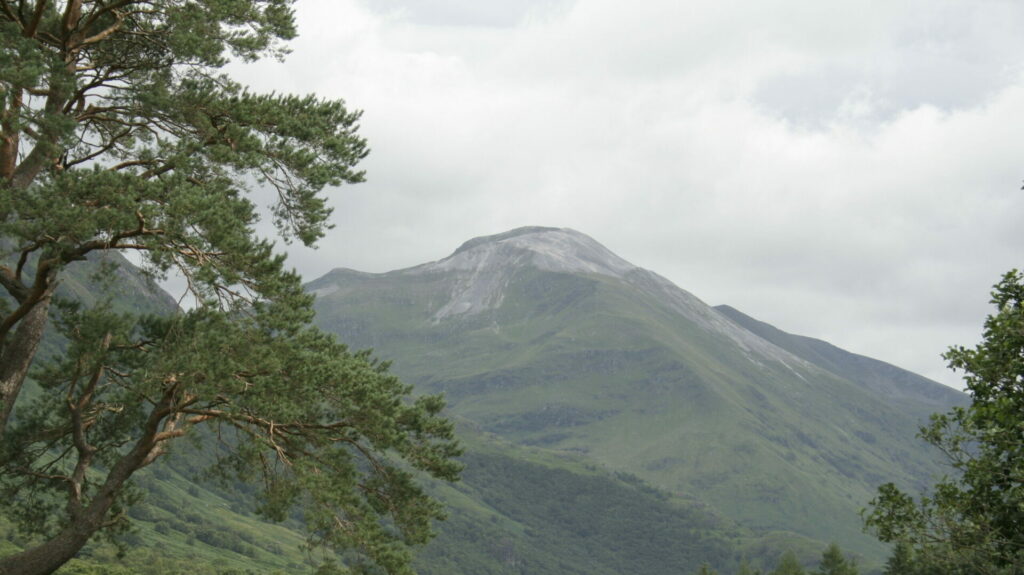
Ben Nevis from the start of Glen Nevis
Now that there is a bit of background on why this was not a competition or a mad last minute idea but the stitching of a long time desire for existing in places I had visualised in very tought times of my life, I hope to have draw a picture of the kind of feelings I had when I set out to walk from Stonehaven.
I left Inverness knowing what I was getting myself into. The last long trek I did happened just after lockdown ‘really’ finished and I had delivered my dissertation. I wandered for about five weeks, covering over 500km on foot, with no deadline or goal other than to be out there.
Glen Elchaig & Loch na Leitreach, 2022
Then, around the summer of 2022, I fell ill. Whether it was long COVID or Lyme is still a mystery. I was partway through the Cape Wrath Trail, and as I approached the bottom of the Falls of Glomach, I felt strangely tired and feverish. Shivering, I set camp by a wee forest just about where the Iron Lodge is, in Carnach, and by now, I had a full-blown fever. I curled up in my tent for about 16 hours, unable to move or eat, just drinking water. After a long sleep, I could start moving again; however, I had pain and itches everywhere, especially on my back. I took my phone and made pictures to assess what was going on, and there they were, about eight ticks on my back, just under my bra line, then two on my legs, and one on my arm.
I walked from Carnach to Doune so I could ask someone to remove them from my back. I could see them with my phone, but could not reach them. I had a knot in my stomach all day. Some lovely lady from New Zealand was kind enough to remove them one by one, and with a lot of pain, I went to Skye to get some advice on what to do. They sent me to my GP, who, by all odds, dismissed the possibility of Lyme but suggested that long Covid was the culprit. After this event, I was tired all the time, and I had almost no energy to trail or to do long distances. I work from home and have to take naps every day, as I get drowsy and struggle to lift my head around 10 am and 2 pm. A few times, I was out and about for less than 4 days, and then I was so tired I couldn’t do anything physical for weeks. It wasn’t until February 2023 that I began training again. The one thing I never failed to do was the Glen Affric way—every year since 2021, at some point in the spring, summer, or autumn, I have been up that way.
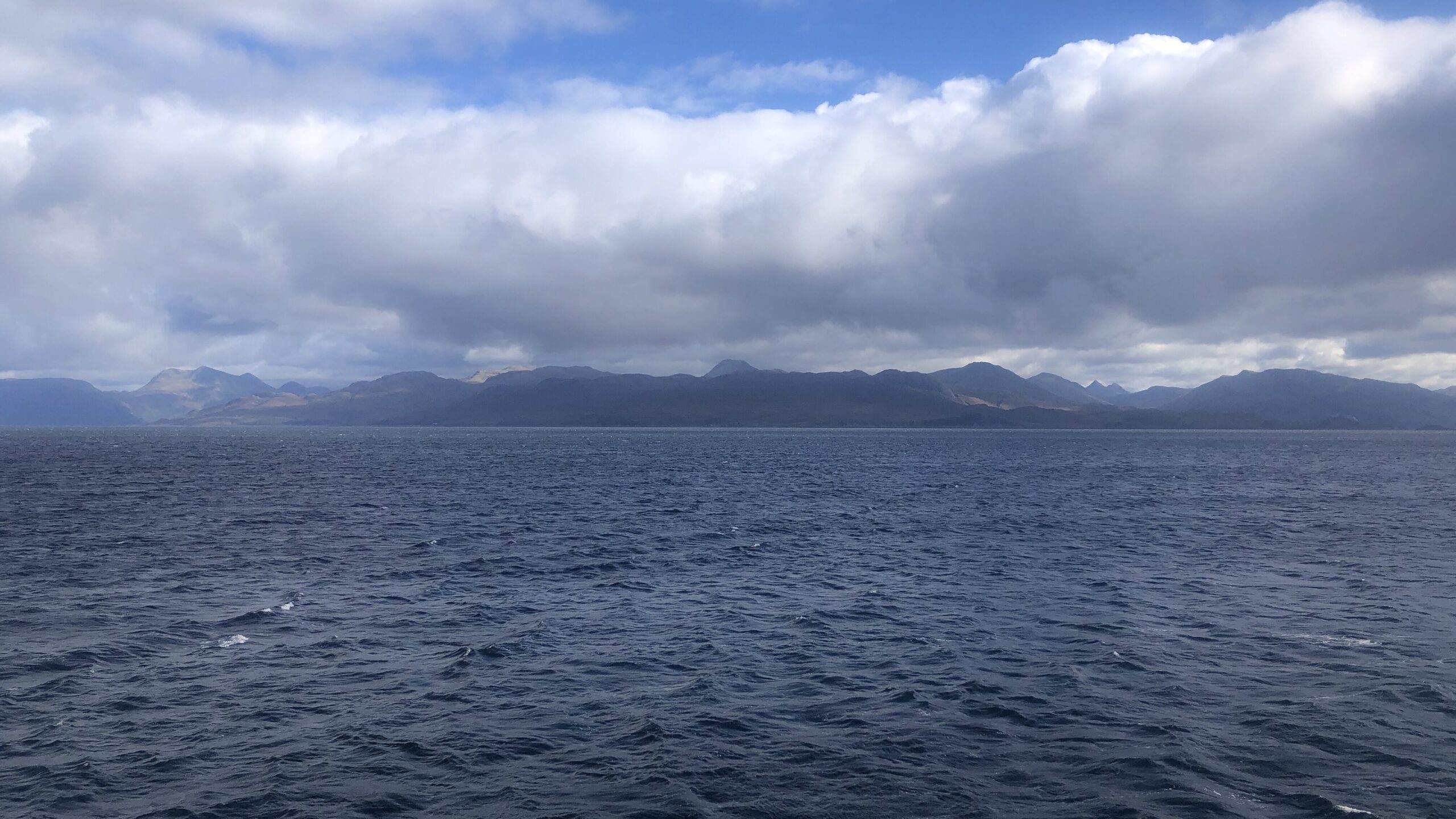
Knoydart & Kintail from Sleath peninsula, Skye, 2021.
Completing this path this spring marked the culmination of nearly two and a half years of relentless training and many years of yearning to be back in the hills after I landed in Amsterdam from Quito. Spending some time in that flat country helped me realise that what I loved was being outside in the wild, putting myself through tough paths, and learning to stay humble and alert. The world of people has a way of taking you off track, making you feel fluffy and comfortable, even drowsy, but something in me is relentless, enduring, and strong-willed, and intuitively knows how to fight a good fight and come out better. No matter what you put my way, I will break through and find my way to what brings me joy. And I find joy, as I am safe in what I love, those feelings expand to others. Like a fireball, like a star, bringing warmth, inspiration and laughter to whoever I cross. Some people stay forever, some go out of their own will. Sometimes you’ve got to let them go, too. Not everyone knows how to love a wild woman.
Over the last few years, I have focused on eating, sleeping, and letting go of habits, people, and places that had depleted my energy, both physically and mentally. Somewhere on my Instagram, I wrote that this trail wasn’t a competition, it wasn’t to show anyone anything, but to test where I stand and ensure I know exactly where I want to go now. Clearly, I am better today than I was then. But something really lovely happened at the end of the journey, while sipping a pint of Guinness in Eigg. I saw my teenage self being very proud of who I am today.
This is an introduction to the stories to come, which may inspire others to take on a challenge, perhaps not the same. But to take the same attitude, the same mindset, and put it to work in their lives. And make their child selves proud too.
To stumble and not despair, to succumb to something mightier but not lose myself in it, to give in to something that scares me but not feel unsafe—these are the hills I love. The paths that, sweating, puffing, laughing, crying, with immense pleasure (and quite a bit of pain), I’m willing to walk at any time, any day.
I’m willing to feel the full range of emotions without manipulating them, without the intention to control, contain, or own them—because… who can own what? Who believes they can own the greatness of this expansion? Anyone who thinks they can conquer what life has to offer knows nothing about time, nothing about space, knows nothing about life itself. For there is nothing to control… not even the self.
All we have is feeling and experience, and as such, they are either memories of things that have happened or the direct, naked present moment. If we are honest enough, here, we can lose ourselves. There, and then, we might comprehend, in freedom.
Wtf, I love feeling dissolved into this world I see.
Dissolving into a story you read, becoming a character, feeling their feelings, living their life, even if just for a minute.
Dissolving as in the stupor of some psychedelic experience when your skin ceases to feel like a cage, and you extend beyond everything you touch.
Dissolving the self—as in an orgasm, shared or alone, so long as the whole thing builds up in a place of safety, of feeling, knowing you will float away without crashing down.
The metaphors and the dissolution are not new, but reading about them is one thing, and being in it is another. Being dissolved, not grasping reality, not grasping the ego, not grasping the body, not grasping time, not grasping the limits of my nerves or the matter that builds my body and constitutes my thoughts. But yet, it is not my matter because, in that moment of dissolving, I cease to exist, and everything exists in the silence of totality.
I often write about emptiness, silence, and totality as actual experiences—real as breathing. Maybe I’ve been lucky to find places that trigger me endlessly; perhaps the life I live and the things that happen to me tear away layers of illusion, painfully lifting veils and removing the comfort of the expected, the known. Possibly, my thirsty, truth-seeking soul, unafraid to crawl into the darkest crevices of feelings and thoughts, has been pierced by the sharp tongues of the hardened, bitter ignorance in the hearts of the unloved.
Dissolving is a kind of death. I wonder if learning to dissolve in nature, learning to dissolve in time, might help us prepare for death— for the ultimate participation in timelessness.
Everybody has stuff they want to hide, a collection of unseen truths, an assortment of thoughts and emotions they choose to conceal from the world. At least, that’s how it often appears. Many faces’ endeavour is to mask their feelings, yet the effort is usually evident, betraying the expressions is a deeper fear of exposure, just beneath the surface. Observing individuals engaged in conversation without the benefit of hearing their words creates a unique opportunity to perceive meanings that transcend language. Imagine sitting on a train, surrounded by strangers whose lives intersect for a fleeting moment, each expression telling a story. There’s something candid, innocent, and almost pure about the act of being an observer in such a setting. There is no malice but an appreciation of human nature in its imperfect yet lovable nature.
Through my travelling times I have been present at the crossroads in the lives of some beautiful human beings. As it usually happens, while dealing with mine, I meet more and more people who find themselves amid changes. Some could say that is more than a coincidence, but I doubt the approach. It feels more like a shared human experience, a collective need to connect that arises when a fragment of our existence shatters, leaving an open space where new possibilities can emerge. This aligns with the idea, “In the midst of chaos, there is also opportunity.” When we find ourselves adrift, some seek guidance while others attempt to chart their course. Change is linear; it follows after itself, never ceasing. Yet time is circular; it comes back, repeating the pattern of day and night, the pattern of the seasons, the round clock on the wall marking the hours. But these things are never the same. Spring is spring, but no spring is the same spring. No silence is the same silence, and no one else can experience this moment as I do, not even myself. This moment will never be re-experienced.
Acknowledging the need to ask for directions is, in itself, an act of vulnerability. Fear and mistrust can easily take hold when we are uncertain about our path; stubbornness and recklessness often become the most detrimental responses to confusion. So, how do we navigate toward a more constructive approach in the face of uncertainty? Many Eastern philosophies emphasise the importance of stillness when confronting confusion. In contrast, Western culture often celebrates vocal expression and quick solutions. The global narrative we encounter—through memes, quotes, and various forms of media—presents us with a duality of messages that can feel contradictory yet hold elements of truth.
We oscillate between these two states in our daily lives, often overlooking their significance. Truths and falsities dance in front of our eyes and within our experience, but we have hardly been given the tools to detangle their meanings. We rush from one to the other, perpetually feeling as if we are missing something essential. Many of us, while engaged in conversation, yearn for the stillness of home, yet when we find ourselves at home, we frequently fill the silence with music, television, or the incessant tapping of messages on our screens. Achieving true stillness is a more challenging endeavour than we might anticipate.
I imagine the life of a Buddhist monk, spending their days in remote temples, enveloped in a silence that resonates with the essence of nothingness. How different their experience is, in stark contrast to our bustling lives, as they embrace the stillness many of us find so elusive. Maybe we have a different definition of stillness. We coloured it with some idealistic colours, like this image, the monk, the remoteness, the ritualistic nature of a belief system, a church, or a temple. The narrative we are presented with feels unapproachable, distant and impossible—a stark contrast with our direct experience in bustling cities and fast-paced lives. Suppose we can redefine what this stillness means for our subjective experience. It is possible that we might already experience some timelessness moment every day, zooming out mentally, staring into the nothingness of a thoughtless second, even if it is just brushing your teeth, in front of a mirror or sitting at the bus stop with noise cancelling headphones. The sudden realisation, a crystalising moment of bright light. But if you can’t, imagine a monk in a temple. Do visit your favourite forest. Stop at the crossroads, ask questions and take your time before you move forward.
Might you find yourself comfortably fulfilling someone else’s expectations or under the overwhelming force of the social timeline, walk the path. Walk the path that has no certainties or expectations, walk the path that pulls your heart (which is one with your mind, your soul and all the other words we invented to separate that which is one). Offer no resistance to the path. Scream, shout, cry, laugh, fear, rejoice, repent, revive the original self.
The aim of meditating is to access the part of us, sentiment beings, that is not thinking nor feeling. When we think we are evaluating, judging and organising an experience, brain activity. When we are feeling we are connecting and relating the immediate to the past, to the future through past experiences. The combination of these two processes constitutes our states of being. Meditation techniques aim to disengage your focus on controlling these processes.
Our brain is an organ as any other organ, although it has some of the least understood functions and process, in my opinion, due to the fact that it is this very processes and functions that we are trying to analyse to “objectively” describe them. As an organ, it does what it is suppose to do: process information both internal and external and execute the required actions to continue our existence in its most efficient way possible with the resources we have. It is the executive center. So far it would seem that I am putting forward a functional & computerized concept of the brain. Might it be the case. However is not the mind I am talking about but brain proceses
This book is about me, my explorations, reflections and thoughts, and my experience. This is my story intermixed with other stories, stories of other beings and other things that are not me. Although I might not be doing a lot of “I see”, “I do”, “I feel”, the I is implied. This is my subjective take on the world I find myself in. You and everything else that is, is in this world. As if this was my dream, and only that, my illusion. The sections are organised in a chaotic structure, as it is a task left to my monkey mind and reflecting the nature of it. The photos have been selected to illustrate something in the text, and sometimes, they match the moment I came up with the thoughts I am sharing with you.
Wandering and wandering off the roads and known paths started when I was a kid, and I was not allowed to ride my bike across the paved roads in Pinares. The area had no straight paths. It was a residential area, far from the busy centre of this seaside summer town. At least where I was, very close to the beach, the forest and the lake. I made it my sport to find creative ways to ride as far as possible. Without a map, without navigation, just me and my bike when I was 11. It was not about reaching anywhere, as I knew that paths ended somewhere, but due to the labyrinthical nature of the area’s trails, I wanted to know all of them, every path. Dead ends and all.
As I wrote this, it became clear to a certain degree that is the same I am doing with Scotland. I want to know it all. Know all the paths, and be aware of its geography. Build a complete 3D scan of the land in my head.
We don’t get to know everything in depth. Things change, and in the eternal flux of time, growth and decay are unavoidable. But just like a scholar, I acquired general knowledge of the subject and am now choosing my in-depth subject. Scotland.
People often ask me about the dangers of travelling alone, the loneliness, the skills necessary to succeed, the gear (in this case, usually middle-aged men), etc. The fact that I am a woman has played a significant role in this question; however, people tried to conceal or address it in such a way that I wouldn’t feel offended. But not always. Like my friend Alex, who was bewildered by the idea that I would go hiking alone wearing yoga leggings. Or Donate to whom I had to invent a schedule with hostels so she wouldn’t freak out with my “I’ll throw the tent somewhere when I feel like it is time to sleep” plan.
It is the exact things they feared or rejected that things that fill me with joy. Not knowing where I would sleep, not having a destination, not considering “the gaze” or how others see me, peeing when I needed to and with a view, carrying all the things I needed in my back. Specially curated life. As minimal as possible and as comfortable as I could afford.
While sitting in the first pub I ever sat in Inverness, some 5 years ago, I look outside to the snow-covered road. I do not have a car or know how to drive. Maybe by the end of these stories, I am about to tell you, I will have a driver’s license. I’ll let you know. But for now, I am bound to my two legs and my bike to roam the lochs, the glens and the mountains of Scotland. The snow must be amazing out there, in the Cairngorms. My friend in Cannich fears she’ll be snowed in this week. I wish I was there. I’ll share a detail… the first time I ever saw snow falling, was when I was 17 years old on my way to Bariloche with my high-school class. Until I moved to the Netherlands, I had no direct experience with snowing. And although I am not fond of cold weather, I fell in love with falling flakes. There is an eerie silence on a snowing afternoon, and the type of light coming from the bright, shining, frozen, watery fluff is magic, just like the white sand of the Western Isles beaches. Its whites and blues taking over the vision field forever.
Let me continue with what these stories will be. This is a book about moving, words and change. My interpretation of these concepts might be broader or narrower than yours. It might be that you had already thought the thoughts I thought and saw the things I saw, and nothing you see or read is new information to you. It might also be the case that something you read or see on these pages triggers something in you; even though the information is not new, it casts a different light on the structures of your thinking. Or it might be gibberish, nonsense, words without any meaning. Like the discourse of the Mad Hatter.
Whatever this book does for you, I am grateful if it does something. Combating numbness in a world of illusionary realities is a challenging job. One way or the other, most of us fall into a state of apathy at least once in our lives. The man-made world becomes easily predictable, routines, timetables, categorised, and organised in linear manners, forcing the flow and ebbs of nature to fit the limitation of our understanding.
I only have two games on my phone; one is called Dots, and the other is Peak. Both are designed to keep your brain from dulling, but I prefer to think of them as meditative. When I play, my inner dialogue runs wild—like the ADHD child I am. It’s a jumble of thoughts, distractions, and half-formed ideas. But even though I’ve long outplayed both games, I continue to enjoy them. They remind me of the challenges I’ve already conquered.
It’s a bit like how I feel about life sometimes. I keep moving forward, even though I’ve already surpassed many of the big milestones. The house, the tree, the family, the book, the traveling, so many adventures—I’ve done most of it. Yet, I’m still excitedby whatever new challenge comes my way. There’s a strange joy in the pursuit, even when the finish line seems far behind me.
Is reaching the top the end of the challenge?
The ongoing challenge of joy is a metaphor for what remains to be done after we achieve something big—something that once defined who we are. We spend so much time working toward a goal that when we finally reach it, it feels like both a triumph and an anticlimax. The pursuit of a specific goal can be a powerful force, motivating us to wake up every day, live through whatever needs to be lived, and do whatever it takes to drag the dream into reality. But what happens after the goal is achieved? That’s when we often face a kind of partial happiness—a hollowness we weren’t expecting. And this is where the challenge of ongoing joy emerges. It’s in that space between achievement and contentment, in the tension between the milestone reached and the next one looming on the horizon.
In a book, in between chapters there is always some type of emptiness. That final point that you see coming as you read. There is a tension and a resolution, the knowing that something is ending or visualisation of white space or a blank page, a number and a capital letter marking the transition. I like to imagine this is the same as that emptiness between an end and a new beginning. The still moment between exhaling and breathing in fresh air. Often people say that a new beginning means a new, fresh, blank book. But that would be like deleting everything that happend before, throwing a note book full of stories away. I doubt that’s the case. I will call it a turn of page, or a new chapter in an ongoing book with one only possible end. We will all eventually die. And that is the end of each and every of our stories.
“Believe it or not […] violence has declined over long periods, and today we may live in the most peaceable era in our species’ existence. The decline, to be sure, has not been smooth […]. But it is an unmistakable development, visible on scales from millennia to years, from the waging of wars to the spanking of children” (Pinker, S., 2011, The Better Angels of our Nature)
I turn my eye to my everyday battles, the sexism and racism I still experience in the streets and online. I realised that I often find myself experiencing the world in an opposite perspective to what Pinker’s quote portrays. However, I agree with the central premise that violence has decreased throughout history. What we witness today is still brutal and biased. However, we are experiencing less violence than at any other time in history. How can this assertion be justified without cancelling the voices of all who work today to end racism and sexism? How can we agree with such statemennt when we the world is still at word in the name of property and religion? How can I say this just some days after Tyre Nichols’s funeral? What is the point of bringing this subject to light? Because what such a statement achieves in the general public is blindness, it justifies numbness; worst of all, it inoculates against feeling outraged at inequality. In an article in The Guardian, John Gray criticised Pinker (and Peter Singer) for praising the Enlightenment ideas that so much have contributed to the inequality of both is and gender we are struggling to eliminate today.
There are several scenarios we have to take into consideration. Global scale, national scale, gender scale, race scale, etc. Of these scenarios or frames, when we look at their history, we can constate that the level of violence experienced has diminished. For example, although gendered violence is still a global problem, it was less than 150 years ago when it was accepted, tolerated and sometimes even encouraged by both religions as the state. We globally raise against regimes that what to perpetuate policies of gender violence. This is a positive outlook, and the reasoning behind its sound, yet left without a further explanation, has a potentially dangerous outcome.
On the one hand, it would allow those who perpetuate the negative models of freedom to claim that there is no urgent need to change how we behave towards one another. On the other hand, it would relax those who actively work towards it, offering a sense of completion that is not yet true. I don’t know in what context Pinker state this, and taking on reading the whole work is not in my winter ’23 schedule. I was revising old lecture notes on Hegel and came across this quote by psychologist Steve Pinker. I was reflecting on freedom and morality. I am dedicated to reading some giants this winter: Hegel’s Phenomenology of the Spirit (1807) and Merlau-Ponty’s Phenomenology of Perception (1945). I give myself time until the end of March. Some might say that is enough time, yet some dedicate their academic life to just one of these texts.
In my last semester at the UvA, I was inscribed to follow a vibrant course on Merlau-Ponty. However, I needed more focus and enthusiasm. It was 2021, the global lockdown had been going on for almost two years, and following philosophy courses via zoom made me depressed and demotivated. Therefore, I dropped out to put all the energy and focus I could gather into writing my thesis.









Leave a Reply